


- FOCUS TOPIC
Mystery Shopping: What Swiss Retail Banks Reveal
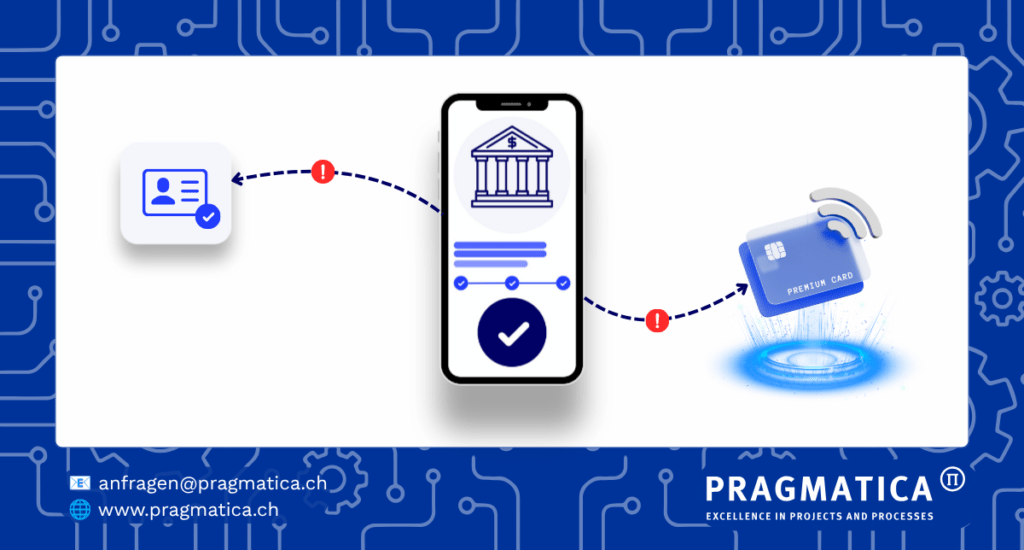
Set up quickly, never used: Why digital onboarding in banking doesn't begin until after the deal is closed
Pragmatica analyzed leading Swiss retail banks as part of a mystery shopping study:
The analysis covered cantonal banks, major retail banks, as well as challenger and neobanks. The analysis is not a scientific study, but rather a practical assessment from the perspective of customer expectations and the customer experience.
- Is the bank’s clientele provided with clear guidance?
- Do customers know what to do next?
- Do they experience initial, tangible added value, and is that momentum leveraged to highlight relevant service offerings?
What the Market Analysis Shows
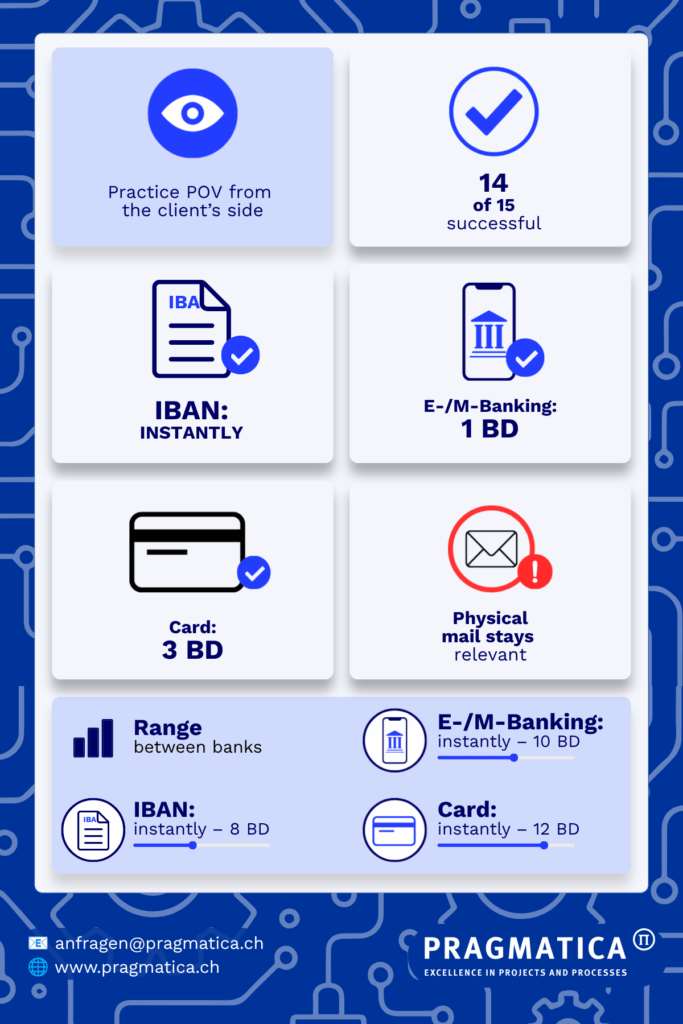
- IBAN: Available immediately in most cases
- E-/M-Banking: Available after 1 business day, on average
- Card: Available on average after 3 business days
- 7 banks offer instant enabling and e-/m-banking activation
- 3 banks offer instant card issuance
At the same time, significant differences remain. The timeframe for providing an IBAN ranges from immediately to 8 business days; for e-banking and mobile banking access, from immediately to 10 business days; and for the card, from immediately to 12 days. More than half of the banks still rely on physical mail—and thus fail to meet the expectations of many new customers for a fully digital onboarding process.
Even more importantly: After opening an account, many banks go quiet—with the only interruption being physical letters containing the card and login information. There is often no clear strategy for guiding new customers toward their first active use of the account. Neobanks like Revolut and Neon show how it’s done.
How does your bank rank in the onboarding comparison?
We analyze your customer journey, identify gaps, and prioritize quick wins. Get in touch for a no-obligation session!
Where banks are wasting potential
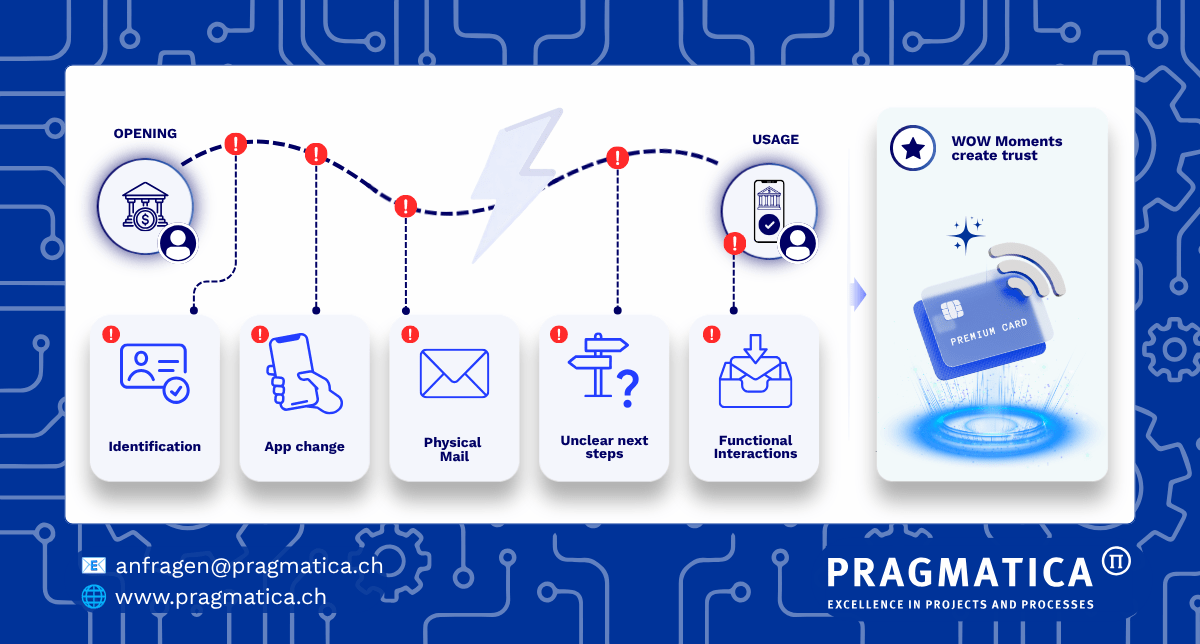
Common fractures include:
- Switching between multiple apps and having to log in repeatedly slows customers down
- Physical mail interrupts digital journeys.
- The next steps aren’t always clear.
- Welcome messages provide information but do not engage
- True “WOW” moments are rare.
- Feedback is rarely sought after onboarding—potential for improvement remains untapped
An IBAN that is immediately visible, structured welcome emails that guide customers through the first few weeks, seamless app activation, well-designed mobile journeys, or a high-quality card presentation. Moments like these build trust and increase the likelihood that customers will actually use their new banking relationship.
The First 90 Days Are Crucial
Three archetypes emerge during the activation phase:
Strong Enablers Without Follow-Through Momentum
They make the account, app, and card available quickly, but then hardly capitalize on that momentum to encourage further use or offer relevant promotions.
Aggressive Activators
Frequent reminders about making a first deposit or using the service can draw attention, but they can quickly come across as intrusive.
Constant Companions
This group uses regular newsletters or app notifications. However, personalization is often still lacking. Generic communication is no substitute for a customer journey that is based on the customer’s actual behavior.
From Onboarding to an Active Customer Relationship
Key questions include:
- Which activation triggers are missing: login, first card use, first payment, or receipt of pay?
- How much communication is “just right” —and which communication is behavior-based rather than generic?
- How is the transition to the self-service catalog managed (CLM events)?
A good place to start is with an Onboarding & Activation Quick Check:
In 2 to 3 weeks, we’ll analyze your customer journey, identify gaps, and prioritize the most important quick wins.
Act now
Schedule a no-obligation session with Pragmatica and take advantage of our service offering, experience and expertise.
We’ll show you how your bank stacks up against the competition, what potential still exists in your onboarding experience and in customer activation, and which measures will yield quick results.
Contact

Dominik Weber
Learn more
My Expertise
- Project and Program Management in banking
- Digital banking and digital transformation
- Business Analysis & Requirements Engineering
Relevant work experience, qualifications and training
- > 25 years of project and program management
- > 25 years of digital banking expertise)
- > 20 years of business analysis / business requirements engineering
- > 20 years of business excellence & digital transformation
- MAS Business Consulting
- Eidg. Dipl. Organizer


